
Building a German Prefabricated House in Switzerland: Customs, Standards, Process
Building a German prefabricated house in Switzerland is possible - but it is not a simple move across the border. This guide considers house construction from the export perspective: delivery areas of German manufacturers, the basics of the SIA standards and the cautious classification of customs and value-added tax, since Switzerland as a non-EU country requires an import.
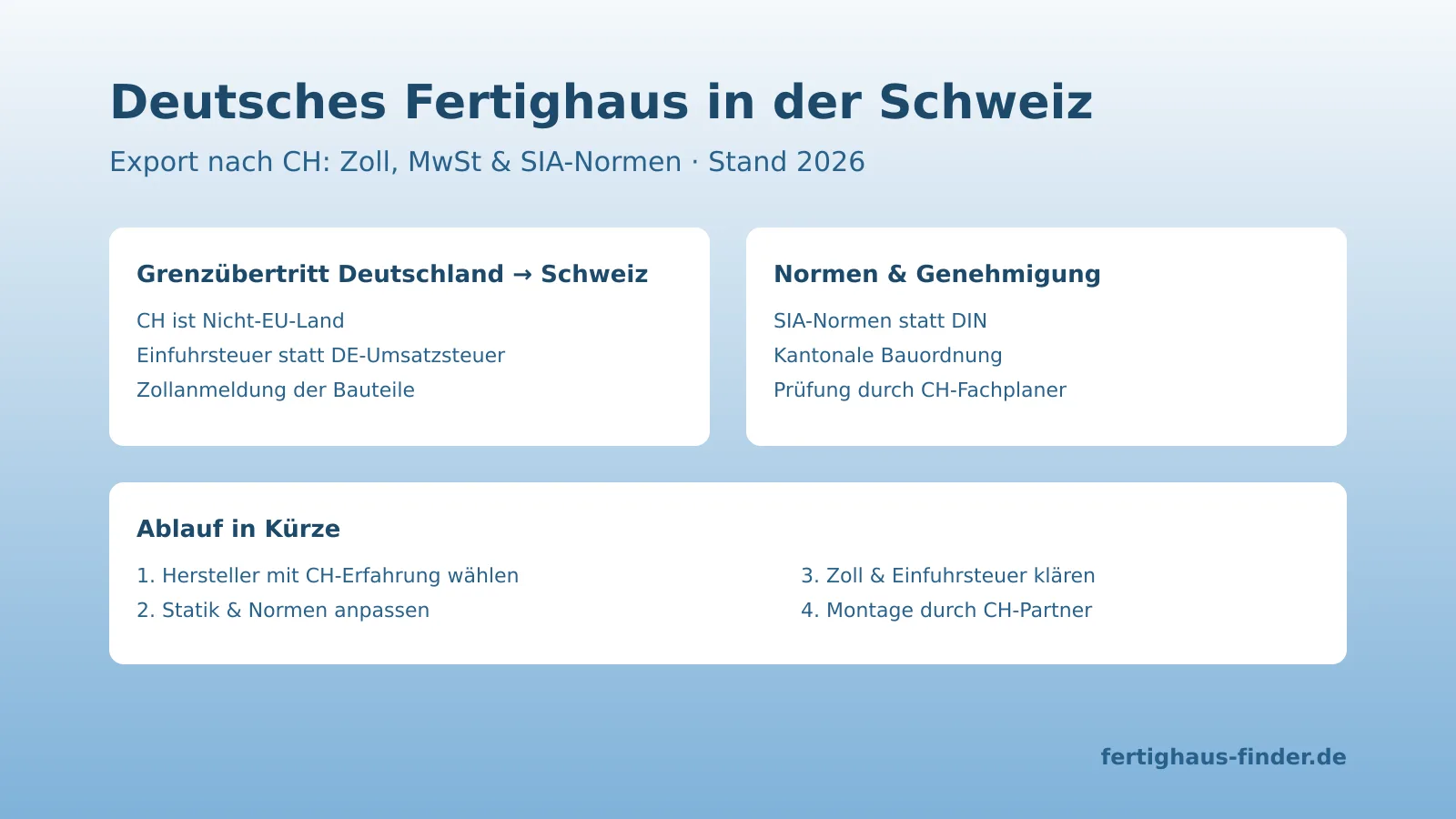
Building a German prefabricated house in Switzerland is generally possible - but it is not a simple relocation of the building components across the border. Because Switzerland is not an EU country, customs and import tax come into play, and instead of the German DIN standards the SIA standards apply. This guide considers house construction from the export perspective: What German manufacturers should consider for a delivery to Switzerland, which standards apply and which customs and tax questions should be clarified at an early stage. A general country overview is additionally offered by the page Prefabricated house in Switzerland.
Can I build a German prefabricated house in Switzerland?
Short answer: Yes, a German prefabricated house can generally be built in Switzerland. In practice, however, this means that the components must be exported, cleared through customs and planned and checked according to Swiss requirements. Crucial is a manufacturer or project developer with experience in exporting to Switzerland who knows the SIA standards, the cantonal building regulations as well as customs and import tax. Without this experience the project quickly becomes complex.
The prefabricated construction itself is well suited for transport because the elements are prefabricated in the factory and delivered for assembly. The difference from a new build within Germany lies less in the building technology than in the legal and tax framework conditions at the border.
From the builder-owner perspective this means: The real challenge is not the house but the organization. Those who underestimate the export risk delays at the border, unclear liability issues in case of transport damage and additional tax demands. Those who set up the process cleanly from the beginning and work with an experienced partner can build a German prefabricated house in Switzerland just as predictably as a house inland. The key is to know the additional steps early and to secure them contractually.
Which German manufacturers deliver to Switzerland?
Short answer: Whether a manufacturer delivers to Switzerland depends on the respective delivery area and should always be asked directly from the provider. Some companies are explicitly active Europe-wide and also build houses outside Germany; this includes projects in Switzerland depending on the provider. Other manufacturers limit their delivery area to certain regions. Clarify specifically before selection whether Switzerland is part of the delivery area and whether the provider organizes assembly and customs clearance.
Some German manufacturers explicitly state Germany and Europe-wide as delivery area - an indication that projects outside Germany are possible. However, whether Switzerland is specifically served is decided on a case-by-case basis. You can find a neutral overview of the providers with their respective details in the Provider overview. For a general market overview for Switzerland the country page helps Switzerland.
Clarify the delivery area at an early stage
Before you buy a building plot in Switzerland you should clarify with the desired manufacturer whether it delivers there, who takes over the assembly and how the customs clearance is regulated. These three points often determine whether an import makes economic sense.
What role do the SIA standards play?
Short answer: In Switzerland the German DIN standards do not apply but the standards of the Swiss Society of Engineers and Architects (SIA). They regulate among other things statics, thermal insulation, fire protection and construction process. A German prefabricated house must therefore be planned and tested in such a way that it meets the relevant SIA requirements and the cantonal building regulations. As a rule, builder-owners engage a Swiss specialist planner or engineer for this who verifies the statics and building physics according to SIA.
In practice this means: A house type proven in Germany is not simply adopted unchanged but adapted to the Swiss requirements. Binding information on the applicable standards and the building permit is provided by the responsible municipality and the cantonal authorities. Professional associations such as the SIA provide the standards collections.
The cantonal peculiarities also include that the requirements for energy efficiency and building envelope can vary regionally. What is sufficient in a German federal state does not automatically have to meet the Swiss requirements. An experienced specialist planner checks the building physics and adjusts insulation, windows and building services so that the house achieves the required characteristic values. This adjustment is not a formality but a prerequisite for the building permit - and it should be clearly regulated in the manufacturers offer or in a separate planner contract.
For builder-owners it is advisable to clarify the responsibility for the standards verification at an early stage: Does the German manufacturer take over the adaptation to the SIA standards or do you commission a Swiss engineer for this? Both ways are possible but they must be fixed from the beginning so that no planning gap arises.
Find manufacturers with export experience
Bringing a prefabricated house across the border works best with a provider that knows delivery area, standards and customs. Request free and non-binding offers and clarify directly whether Switzerland is part of the delivery area.
What applies to customs and value-added tax?
Short answer: Since Switzerland is not part of the EU the importation of building components is treated as an import under customs regulations. Instead of German VAT Swiss import tax is due on importation and the goods must be declared to customs. German deliveries abroad may be exempt from German VAT under certain conditions. Because the rules are complex and subject to change you should clarify the tax treatment at an early stage with the manufacturer and expert advice. This guide does not replace tax or customs advice.
Principles: Construction within Germany versus export to Switzerland
| Aspect | Construction in Germany | Export to Switzerland |
|---|---|---|
| Customs status | EU internal market | Non-EU, import |
| Tax on delivery | German VAT | CH import tax |
| relevant standards | DIN | SIA |
| Permit | State building regulations | Cantonal building regulations |
| Customs declaration | not required | required |
Binding information on import and taxes is provided by the Swiss customs and security authority, the Federal Office for Customs and Border Security. Plan sufficient time for the processing and coordinate it with the manufacturer.
It is important to clearly assign who acts as importer and handles the customs formalities. Some manufacturers deliver free to the construction site and handle the import themselves others hand over the goods at the border so that the builder-owner is responsible for the import. These so-called delivery conditions determine who bears which costs and risks. Have the conditions confirmed in writing and factor in the import tax as well as any costs for the carrier and customs processing in your budget from the outset. They can noticeably increase the final price.
Because tax and customs rules are complex and can change expert advice from a tax consultant or customs specialist is strongly recommended. The principles outlined here serve only as a guide and do not replace individual advice for your specific case.
How does the import process work step by step?
Short answer: The general process includes five steps: selection of a manufacturer with export experience adaptation of statics and building physics to SIA standards obtaining the cantonal building permit clarification of customs and import tax and finally transport and assembly by a local partner. Each of these steps should be clearly defined in the contract to avoid any gaps in responsibility.
- Select manufacturer or building contractor with experience in exporting to Switzerland.
- Have statics thermal and fire protection adapted to SIA standards.
- Obtain cantonal and municipal building permit.
- Clarify customs declaration and import tax with expert advice.
- Clearly assign transport customs processing and assembly in the contract.
- Plan time buffer for border processing and official procedures.
Document responsibilities in writing
The most common stumbling block in export is an unclear division of tasks: Who clears the goods through customs who is liable for transport damage who carries out the assembly. Document these points in writing before production begins. This avoids delays and additional demands at the border.
Those who want to classify the costs in principle will find reference values in the overview Prefabricated house prices - it refers to the German market but helps with understanding the price structure. The guide explains additional construction cost basics House construction costs.
When transferring German prices to Switzerland caution is required. The values given apply to the German market and cannot be converted one-to-one. In Switzerland additional items are added to the pure house price such as cross-border transport customs processing import tax and adaptation to SIA standards. The local wage and price level also differs. Therefore use the German guide values as a rough orientation for the price structure not as a concrete calculation for your Swiss project. A binding offer including all border-related items provides the necessary clarity. When selecting a suitable export manufacturer it helps to first be able to compare prefabricated house manufacturers .
German prefabricated house in Switzerland - start well prepared
From manufacturer selection to customs processing: A provider with export experience takes many questions off your hands. We will connect you free of charge and without obligation with suitable manufacturers so that you know the delivery region standards and costs at an early stage.
What does your dream house really cost?
Request free suitable offers from verified manufacturers and compare the square meter prices for your construction project.
Compare house prices now