
Equity for House Construction: How Much You Need in 2026
How much equity do I need for house construction? The answer determines the interest rates, installment and security. This guide explains proven rules of thumb for 2026, shows how much own contribution is sensible, and how the equity ratio tends to affect the interest rate.
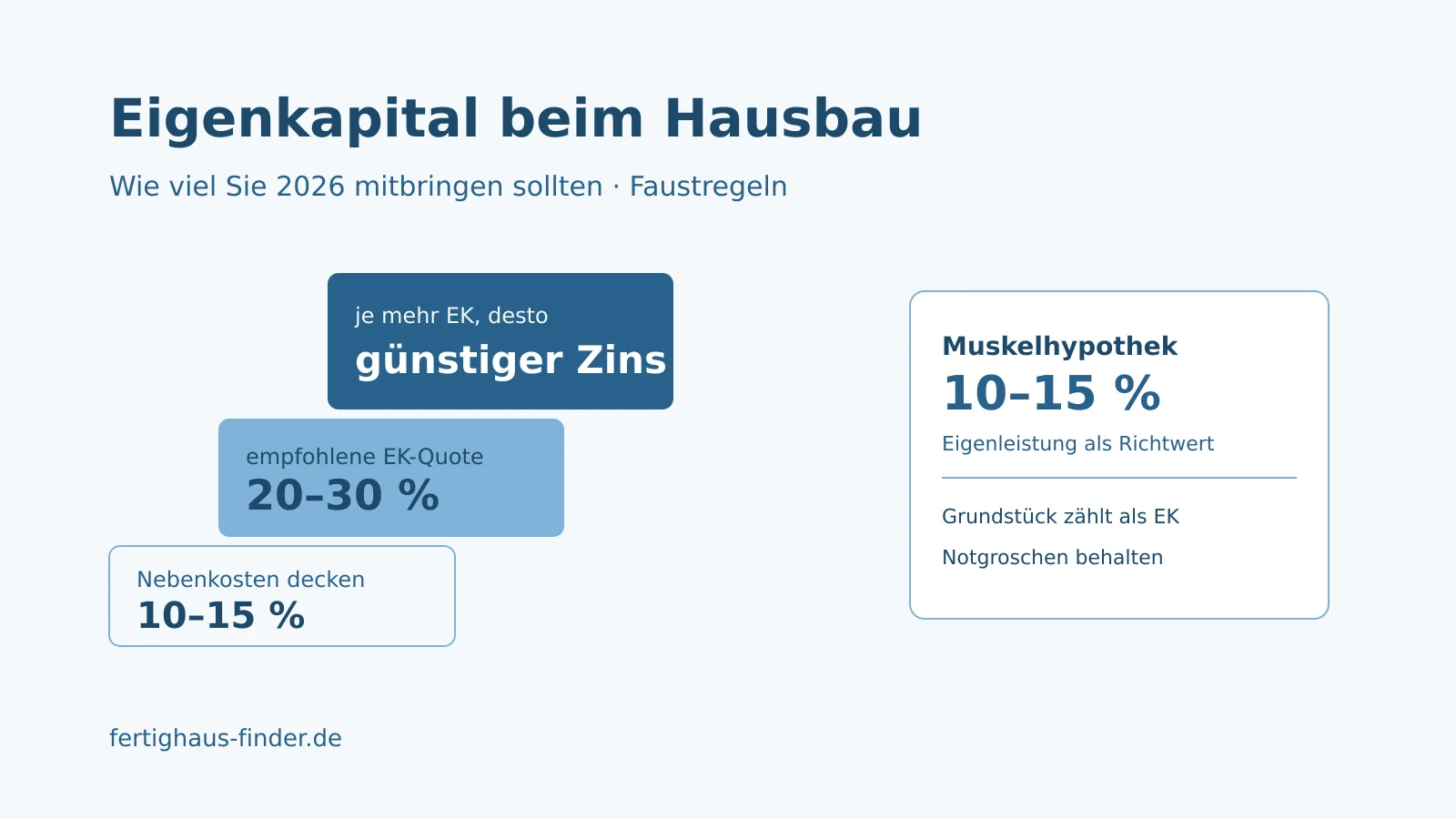
"How much equity do I need for house construction?" is one of the first questions before financing – and the answer determines the interest rates, installment and security. This guide explains proven rules of thumb for 2026, shows how much own contribution is sensible, and how the equity ratio tends to affect the interest rate.
Short Answer: As a rule of thumb: At least the purchase ancillary costs of around 10–15 % should be covered from equity, better are 20–30 % of the total costs. The higher the equity share, the lower typically the interest rate and the monthly rate. Financing completely without equity is possible, but more expensive and riskier.
How Much Equity Should One Bring for 2026?
Short Answer: The common rule of thumb states: Purchase ancillary costs – i.e. land transfer tax, notary, land registry and if applicable broker – to be fully financed from equity. These are around 10–15 % of the total costs depending on the federal state and project. You will fare better with 20–30 % equity because banks reward this with noticeably better interest rates and the rate remains affordable.
- Purchase ancillary costs (10–15 %) preferably completely from equity.
- 20–30 % equity is considered a solid basis for good conditions.
- Do not fully use emergency fund of several monthly expenses.
- Existing building plot counts as equity.
- Include building society savings, securities and gifts.
What exactly the ancillary costs consist of is explained in the overview of the Construction Ancillary Costs as well as the detail page on Equity for House Construction. How large your house should be is determined in part by the budget – the overview of the Room Sizes in the House.
How Does the Equity Ratio Affect the Interest Rate?
Short Answer: The higher the equity ratio, the lower the risk for the bank – and typically the lower the interest rate. Those who bring in a lot of equity finance a smaller sum and often reach better loan-to-value classes. With very low equity the interest surcharge increases. The following table shows the tendency – specific interest rates depend on the individual case and market environment.
Equity Ratio and Interest Surcharge (Qualitative Tendency, Stand 2026)
| Equity Ratio | Interest Surcharge Tendency | Classification |
|---|---|---|
| 0 % (Full Financing) | Significantly Higher | Only with Very Good Credit Rating |
| ca. 10–15 % | Increased | Ancillary Costs Covered, Feasible |
| ca. 20 % | Favorable | Solid Standard Situation |
| 30 % and More | Very Favorable | Best Condition Classes |
Interest Rates Are Snapshots
The table shows only the direction, no specific percentage values. Actual conditions depend on creditworthiness, property, term and the current interest level. A current overview is found in the classification for the Construction Financing 2026.
Realistically Estimate Financing Room
Compare offers free of charge and without obligation and find out which house is affordable with your equity.
What Are the Benefits of the Muscle Mortgage – and What Are the Limits?
Short Answer: Muscle mortgage refers to own labor that is recognized as an equity-like contribution. Banks usually only count a limited portion – realistically about 10–15 % of the build cost. Those who are handy can save on painting, flooring or interior fit-out. Limits are in time, ability, liability and for trades that require permits.
- Usually only a limited portion of the build cost is recognized.
- Suitable: Painting, Wallpapering, Floor Laying, Garden Setup.
- Not Suitable without Expert: Electrical, Plumbing, Structural, Roof.
- Realistically Assess Time Needed – Delays Cost Money.
- Warranty Is Void for Self-Executed Work.
Which trades are suitable for own labor and how much they save is explained further in the guide Own Labor for House Construction.
Is House Construction Possible Completely Without Equity?
Short Answer: Full financing without equity is possible but requires secure income, good creditworthiness and usually a higher monthly payment. The interest rate is higher and there is no buffer for value fluctuations. For some households with stable income it can nevertheless be the way into home ownership – an honest calculation is essential.
All requirements, opportunities and risks of a full financing are explained on the detail page Build House Without Equity.
Conclusion: Better to Finance Solidly Than Tightly
Equity reduces interest, rate and risk at the same time. Cover at least the ancillary costs from your own funds, aim for 20–30 % if possible and retain an emergency reserve. Own labor can supplement but does not replace equity. When comparing, also pay attention to clear area details – the guide explains how living area is calculated. Calculate Living Area. The construction sum against which your equity requirement is measured can be determined with the Prefabricated House Cost Calculation and with the current Prefabricated House Prices 2026 estimate. Independent information on construction financing is provided by the Consumer Center.
Find Suitable House for Your Budget
Compare offers free of charge and without obligation and find a house that fits your equity and your desired rate.
What Does Your Dream House Really Cost?
Request free matching offers from verified manufacturers and compare the square meter prices for your building project.
Compare House Prices Now