
Prefabricated house in old age: barrier-free and low-maintenance for the generation 50 plus
Anyone building new in old age is best thinking on one level: The bungalow is the classic for the generation 50 plus, because it manages without stairs and can easily be designed to be barrier-free. This guide shows which house types fit, which structural details really count, what a senior-friendly prefabricated house costs in 2026 and which subsidy is available to you.
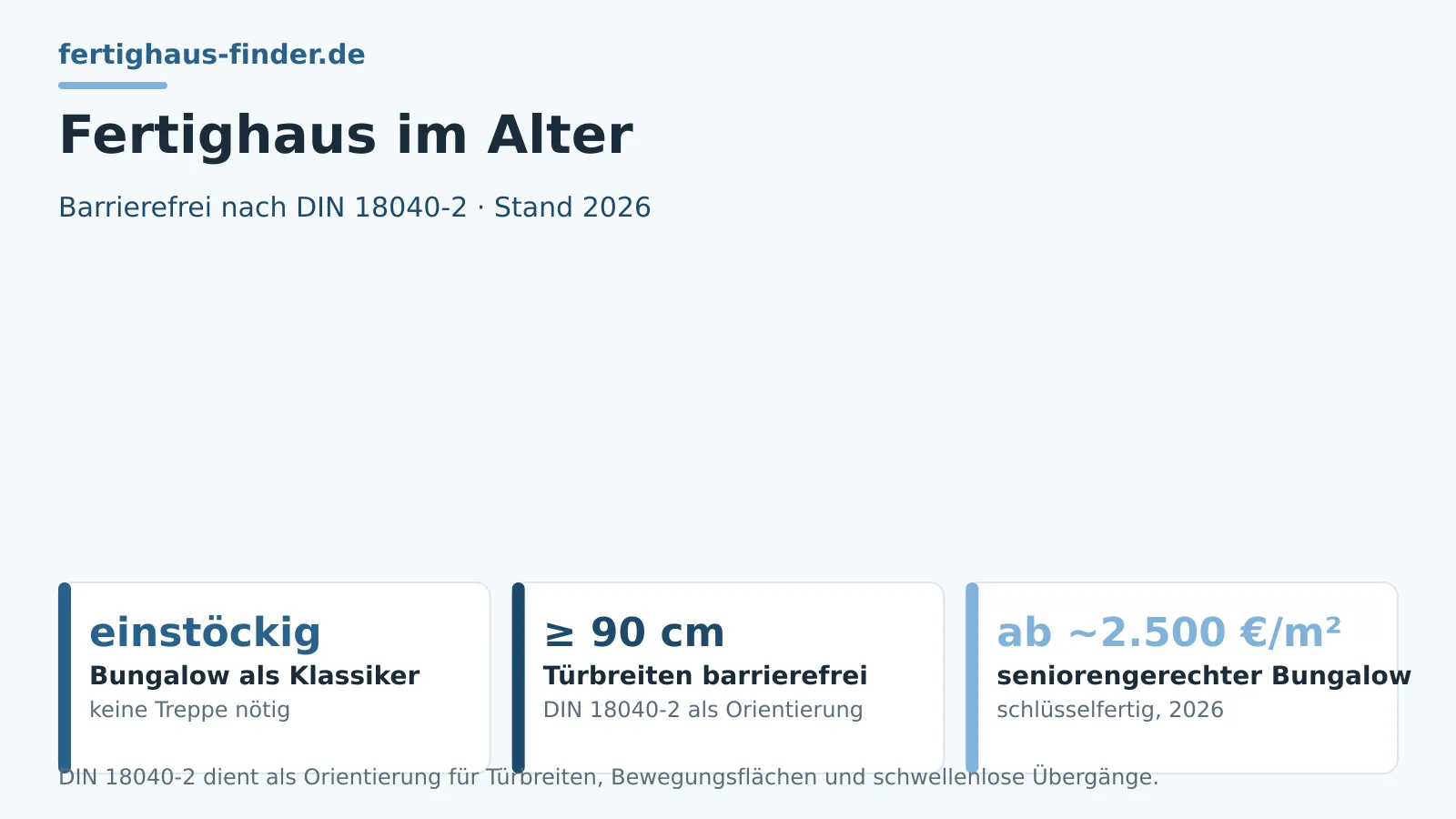
Building a prefabricated house for old age mainly means: planning single-story, barrier-free and low-maintenance. The bungalow is therefore the classic for the generation 50 plus, because it manages without stairs and can easily be designed age-appropriate with ground-level shower, wide doors and threshold-free transitions. This guide shows which house types are suitable, which structural details are really important, what a senior-friendly prefabricated house costs in 2026 and which subsidy options there are for barrier-free construction. The complete overview to the single-story construction type is bundled by the Prefabricated house bungalow.
Which house type is most suitable in old age?
Short answer: For building in old age, the bungalow is the best house type: All rooms are on one level, there is no staircase, and the paths in the house are short. Because you neither have to overcome steps later nor heat an upper floor, the effort for movement, cleaning and heating decreases. Those who want to save area choose a compact bungalow of 80 to 120 square meters. Alternatively, a house with a ground-level sleeping and bathroom area is suitable so that the ground floor alone remains suitable for daily life and the upper floor serves only for guests.
Prefabricated houses are particularly attractive for this target group because the short construction time and the fixed price provide planning security - two aspects that often count more in advanced age than for young families. An overview of single-story floor plans is offered by the house type Bungalow, specially for the target group of the barrier-free bungalow for seniors.
Which structural details make a house age-appropriate?
Short answer: An age-appropriate prefabricated house lives from few but consistent details: threshold-free transitions at all doors and to the terrace, at least 90 centimeters wide doors, a ground-level shower with space for a seat, sufficient movement space in the bathroom and in the corridors as well as slip-resistant floor coverings. Light switches and sockets should be at convenient height. The standard DIN 18040-2 serves as orientation for barrier-free living. It is important to plan these points from the beginning because retrofitting is usually expensive and complex.
Many features cost hardly any more in new construction provided they are taken into account in the planning - for example wider doors or a ground-level shower. Others are useful pre-provisions: Those who reinforce the bathroom walls in advance for later grab bars or install empty conduits for a stair lift save significantly later. Detailed planning advice can be found in the Guide to barrier-free building.
Barrier-free vs. barrier-reduced
Not everyone needs a fully wheelchair accessible house. "Barrier-reduced" means avoiding the most important obstacles - thresholds, narrow doors, bathtub instead of shower - without strictly following every standard. "Barrier-free" according to DIN 18040-2 goes further and is a prerequisite for certain subsidies. Agree with your manufacturer which level you aim for.
Plan age-appropriate bungalow as fixed price
Single-story floor plans, ground-level shower and wide doors can best be incorporated in the prefabricated house from the start. Compare fixed price offers from several manufacturers with senior-friendly bungalow floor plans free of charge.
What does a senior-friendly prefabricated house cost in 2026?
Short answer: A turnkey, barrier-free bungalow is priced at around 2.500 to 4.000 euros per square meter in 2026 depending on equipment, excluding building plot. Because a bungalow has a larger base area and larger roof than a two-story house with the same living area, the price per square meter is tendentially somewhat higher. In return, the stairs and upper floor are omitted, and the later operating and conversion costs decrease. Barrier-free equipment details only moderately affect the new construction planning if considered early.
Living arrangements in old age in comparison (reference values 2026)
| Solution | Advantage | To be considered |
|---|---|---|
| New construction bungalow (barrier-free) | everything on one level, planned long term | higher m² price, building plot requirement |
| House with living in EG | Reserve in OG for guests/care | Stairs remain |
| In-law apartment in house | Proximity to family, rental income | Separation/sound protection necessary |
| Conversion of existing building | familiar environment | often expensive, not always feasible |
Anyone wanting to plan an apartment for family members or as a rental option will find details in the guide to the in-law apartment. For pure cost calculation the cost calculator helps. Anyone who views their own house also as old age provision should read the guide prefabricated house as capital investment read.
What subsidy is available for age-appropriate building?
Short answer: For barrier-free and age-appropriate building there are various subsidy possibilities in 2026 - for example the KfW program "Altersgerecht Umbauen" which provides grants or loans for removing barriers if funding is available. In addition, energy efficiency subsidies for efficient new builds can be used. The care insurance fund additionally subsidizes measures to improve the residential environment if a care degree is present. Programs and budgets change; check the current conditions and always submit applications before starting construction or renovation.
The energy efficiency subsidy for new builds runs largely parallel to any other prefabricated house planning. How the programs work and which efficiency house standard is required can be read in the Guide to KfW subsidy 2026. A neutral overview of age-appropriate living and subsidy options is also offered by the consumer advice centre.
- Choose single-story bungalow or ground-level living/sleeping area.
- Threshold-free transitions, doors ≥ 90 cm, plan for level-access shower.
- Pre-equip bathroom walls for future grab bars, lay empty conduits.
- Consider slip-resistant floors and conveniently located switches.
- Check KfW, care insurance funds and energy subsidy before construction begins.
- Check offer in writing for included barrier-free details.
Move with or relocate? What matters in the long term
Short answer: Anyone building new in old age should think beyond the present: location, reachability of doctors and shopping, a low-maintenance garden and good connections are just as important as the barrier-free house itself. A compact, single-story new build is often the more sustainable solution than the complex renovation of an old, two-story house. Also consider the value development: A modern, barrier-free bungalow is well sought-after on the market because it suits many phases of life.
Whether you sell the large family house and build new or adapt the existing one depends on building plot, budget and personal attachment. A compact new build permanently reduces operating costs and maintenance effort - and a prefabricated house provides this solution with short construction time and fixed price. Compare several providers before you decide.
No legal or subsidy advice
Information on subsidy programs and standards is general here and does not replace individual advice. Subsidy requirements and budgets change; the binding interpretation is assumed by your manufacturer or the funding agency. Always submit applications before construction begins.
Inquire about barrier-free bungalow with fixed price
Many prefabricated house manufacturers offer tested, senior-friendly bungalow floor plans with level-access shower and threshold-free transitions. We connect you free of charge and without obligation with suitable providers with transparent fixed prices for building in old age.
What does your desired house really cost?
Request free suitable offers from tested manufacturers and compare the square meter prices for your construction project.
Compare house prices nowImportant questions explained briefly
The most common price questions about prefabricated house in old age - compactly answered by the editorial team of Modulhaus-Fertighaus (Stand 2026).
Which house type is best suited in old age?
Which structural details make a house age-appropriate?
What does a senior-friendly prefabricated house cost in 2026?
What subsidy is available for age-appropriate building?
Barrier-free or barrier-reduced - what is the difference?
Does a new build or the renovation of the existing property pay off?
Can I plan an apartment for relatives?
Related topics
- Barrier-free building 2026: Additional costs, DIN 18040-2, subsidy
- Prefabricated house construction time: Why short build phases save money
- Prefabricated house building permit 2026: Costs of the building application
- Turnkey building 2026: Prices and hidden costs
- Prefabricated house material selection: Procedure & cost traps
