
Green Tiny House: Sustainable and self-sufficient in the tiny house
A Green Tiny House combines resource-saving small living with ecological materials and self-sufficient technology. Those who live on a small area already consume less as a result - combined with photovoltaics, storage, timber construction and a closed water cycle a particularly sustainable home is created. This guide classifies which eco-materials make sense, how self-sufficiency works in stages and which provider from our database has specialized in self-sufficient tiny houses.
A Green Tiny House combines two ideas: the inherently resource-saving small living and the conscious use of ecological materials and self-sufficient technology. Those who live on 25 to 50 m² already consume less energy due to the area - combined with photovoltaics, storage, timber construction and a closed water cycle this results in a particularly sustainable home. This guide calmly classifies which eco-materials make sense, how self-sufficiency works in stages and which provider from our database has specialized in self-sufficient tiny houses. An overview of the construction method is given by the Tiny House.
What makes a tiny house a Green Tiny House?
Short answer: A Green Tiny House goes beyond the inherently economical small living: It consciously uses renewable or recycled materials, a high share of self-generated renewable energy and as closed a loop as possible for water and wastewater. Instead of just consuming little, it supplies itself for the most part. How far the self-sufficiency extends depends on the location, the budget and the chosen concept.
The ecological advantage begins with the area: A house with 30 m² needs less building material, less heating energy and less space than a full single-family house. A Green Tiny House enhances this effect through the choice of materials and technology. The guide delves into how sustainability is evaluated for prefabricated houses overall - from the ecological balance to certifications - sustainable prefabricated house.
Eco-materials for the sustainable tiny house
Short answer: Sustainable tiny houses preferably rely on solid wood or timber frame construction, natural insulation materials such as wood fiber, cellulose or sheep wool as well as low-pollutant, diffusion-open surfaces. These materials bind carbon, regulate moisture and ensure a healthy indoor climate. It is important to take an honest look at the entire ecological balance - from the raw material to use to later dismantling.
Ecological materials and their benefit in the Green Tiny House
| Component | Ecological choice | Advantage |
|---|---|---|
| Load-bearing structure | Solid wood / timber frame | binds CO₂, renewable |
| Insulation | Wood fiber, cellulose, sheep wool | natural, moisture-regulating |
| Facade | untreated or oiled wood | durable, repairable |
| Surfaces | diffusion-open, low-pollutant | healthy indoor climate |
| Dismantling | separable by type | circular |
The solid wood construction additionally brings storage mass that protects against overheating in summer - an advantage especially with the large window areas of small houses. Those who value living health pay attention to the material declaration and to the avoidance of problematic adhesives. This makes the small house not only climate-friendly but also pleasant to live in.
Self-sufficiency levels: grid-connected, partially self-sufficient, fully self-sufficient
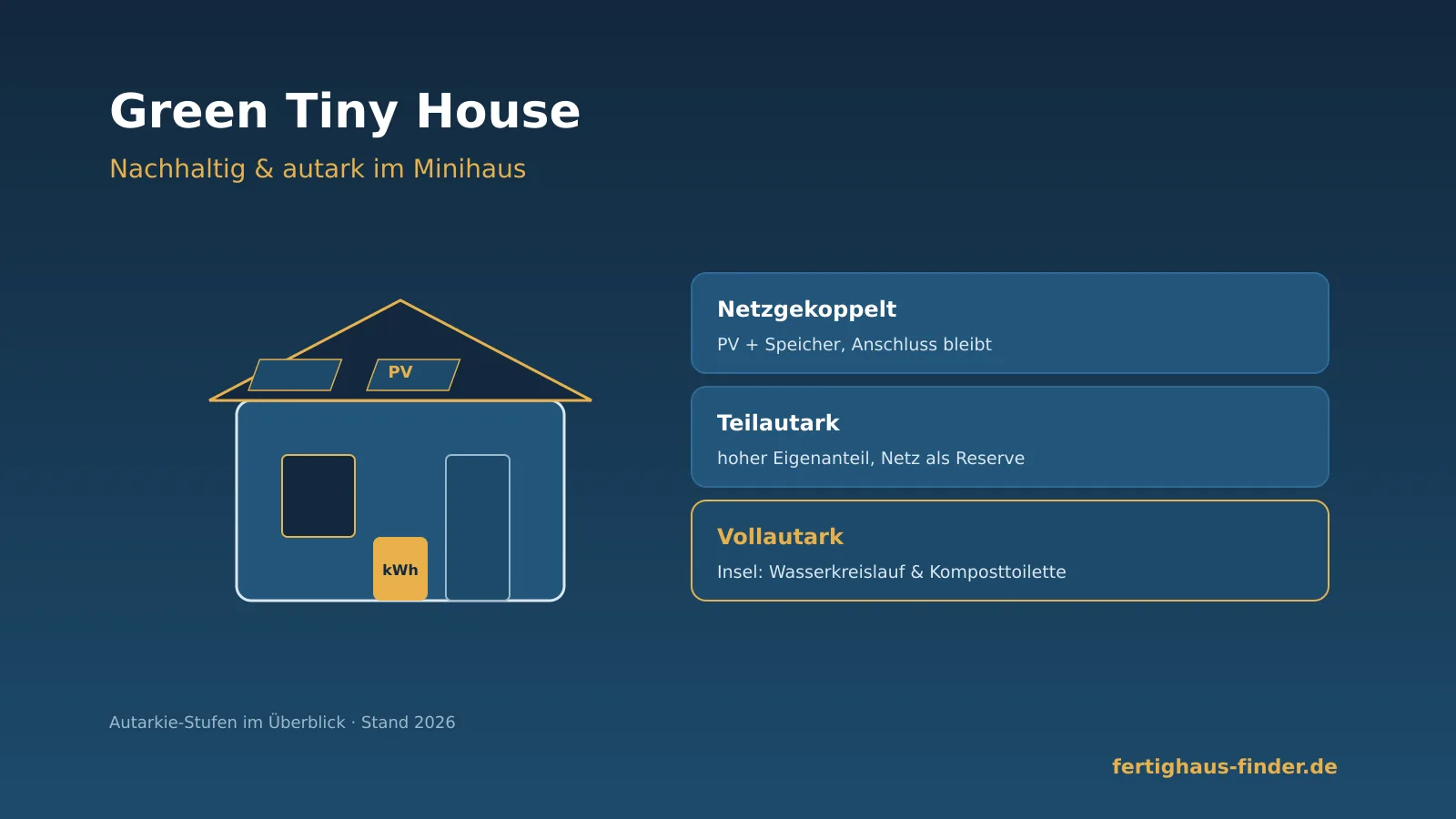
Short answer: Self-sufficiency is not a question of yes or no, but a scale. A grid-connected Green Tiny House generates its own electricity but remains connected to the grid. A partially self-sufficient house covers a high proportion itself and uses the grid as a reserve. A fully self-sufficient house supplies itself completely - with photovoltaics and storage, its own water treatment and a composting toilet. The higher the level, the greater the technical and financial effort.
Self-sufficiency levels in the Green Tiny House (general orientation, Stand 2026)
| Level | Electricity | Water / wastewater | For whom |
|---|---|---|---|
| Grid-connected | PV + storage, connection remains | public grid | Standard building plot |
| Partially self-sufficient | high self-share, grid as reserve | Partial cycle, rainwater | remote locations |
| Fully self-sufficient | Island solution with large storage | Water cycle, composting toilet | off-grid locations |
For most locations, the grid-connected or partially self-sufficient variant is the more economical choice because a fully self-sufficient system requires a very large storage and complex water and wastewater technology. The guide classifies how a high degree of self-sufficiency can generally be implemented in prefabricated houses and which shares are realistic. energy self-sufficient house it.
Fully self-sufficient is not a must
Complete self-sufficiency is technically demanding and expensive. For most building plots, a grid-connected system with photovoltaics and storage already brings a high proportion of self-consumption - with significantly less effort than a real island solution.
Planning sustainable tiny house with self-sufficiency option
Eco-materials, photovoltaics and a well thought-out water concept belong together. We will provide you with suitable providers from our database free of charge and without obligation that build sustainable and, if desired, self-sufficient tiny houses.
Photovoltaics and storage as the core
Short answer: Photovoltaics and a battery storage are the basis of any self-sufficiency in the Green Tiny House. Although the roof area is small, with good orientation it is sufficient for a significant part of the electricity demand of a one- to two-person household. A storage shifts the electricity generated during the day to the evening hours. If an efficient heat pump supplements the heat supply, the self-consumption increases further.
Because a Tiny House has little floor area and little volume, its energy demand is relatively low - an advantage for self-sufficiency. Decisive are the orientation of the roof, a sensibly dimensioned storage and an economical use of hot water. Those who coordinate electricity, heat and hot water achieve a high self-consumption share even with a small system.
- Align PV to the south or east-west, avoid shading.
- Dimension storage appropriate to consumption, do not oversize.
- Choose heat pump or infrared depending on insulation standard.
- Plan hot water economically, supplement with solar thermal if necessary.
- Avoid power guzzlers: efficient appliances and LED lighting.
- Measure consumption to control the system sensibly.
Composting toilet and water cycle
Short answer: For partial and full self-sufficiency in water, a composting toilet and a largely closed water cycle come into play. The composting toilet works without flush water and separates solid from liquid substances, which saves water and reduces the wastewater volume. Rainwater can be collected and treated, graywater from shower and kitchen cleaned via plant filters. This significantly reduces the fresh water demand.
A completely closed water cycle is technically demanding and must fit the local approval situation. Often a mix is sensible: composting toilet to reduce water consumption, rainwater use for the garden and a normal connection for drinking water. The responsible authority clarifies which solution is permitted - the approval question is covered by the guide Site and building law .
Self-sufficient tiny houses from our database
Short answer: Wohnwagon has specialized in self-sufficient modular houses made of solid wood in our database. The manufacturer insulates with sheep wool and offers on request operation via photovoltaics, own water treatment and composting toilet - thus independent of public grids. The floor plans are individually aligned to building plot, sun and wind; the manufacturer determines the price on request.
Wohnwagon shows by example how ecology and self-sufficiency can be combined in a tiny house: solid wood ensures a good indoor climate and a favorable ecological balance, the technology enables operation away from the grids if required. For the model "Modulhaus Autark" no fixed price is stored in our database - here "price on request" applies because the execution is planned individually. Further providers with modular, partly sustainable construction can be found in the overview for the Modular house.
Prices only as real information
For individually planned self-sufficient tiny houses many manufacturers do not specify a list price. Where no price is stored in our database, "price on request" applies deliberately - invented ranges per model would not be serious.
Tiny house thought sustainably: Is it worthwhile ecologically?
Short answer: Yes - a sustainably built and operated Tiny House is one of the most resource-conserving forms of living. Small area, little material, renewable building materials and own electricity together result in a low ecological footprint. An honest look at the entire balance remains important: manufacture, operation and deconstruction. Those who plan consciously live small, comfortable and climate-friendly at the same time.
Whether "Tiny House" or "Tiny Haus" - both spellings mean the same small, resource-conserving living; sustainability does not depend on the spelling but on material, technology and use. Those who want to take the next step will find in the guide Buy Tiny House the purchase criteria and in the article Tiny House costs the classification of the expenses - self-sufficient technology is reflected in both. The classification as Tiny House as house type rounds off the picture.
A Green Tiny House is thus more than a trend: It makes sustainable, largely self-sufficient living on a small area tangible - with ecological materials, own energy and an economical use of water. How far you push the self-sufficiency decides your location and your budget. Those who want to come through the cold season self-sufficiently will find in the guide Tiny House winterproof the appropriate addition to insulation and heating technology. The guide shows how the resource-conserving interior fit-out can be planned Furnish Tiny House.
Realize Green Tiny House with ecological technology
Sustainable materials, photovoltaics, storage and a well-thought-out water concept belong together. We connect you free of charge and without obligation with suitable providers from our database - for a resource-conserving tiny house according to your ideas.
What does your dream house really cost?
Request suitable offers from verified manufacturers free of charge and compare the square meter prices for your construction project.
Compare house prices nowImportant questions explained briefly
The most common price questions about Green Tiny House - compactly answered by the editorial team of Modulhaus-Fertighaus (Stand 2026).
