
KfW 40: Requirements at a glance
The Efficiency House Standard 40 is one of the most demanding new build targets. This guide explains the central parameters for primary energy demand and heat loss. It distinguishes the technical standard from the subsidy and explains the 40-NH seal. This is how you understand the KfW-40 requirements 2026.
The Efficiency House Standard 40 is one of the most demanding goals in new construction and is a prerequisite for the most attractive subsidy programs. But what exactly must a KfW-40 house fulfill technically? This guide explains the central parameters for primary energy demand and heat losses, distinguishes the technical standard from the subsidy and shows which additional requirements apply for the 40-NH seal.
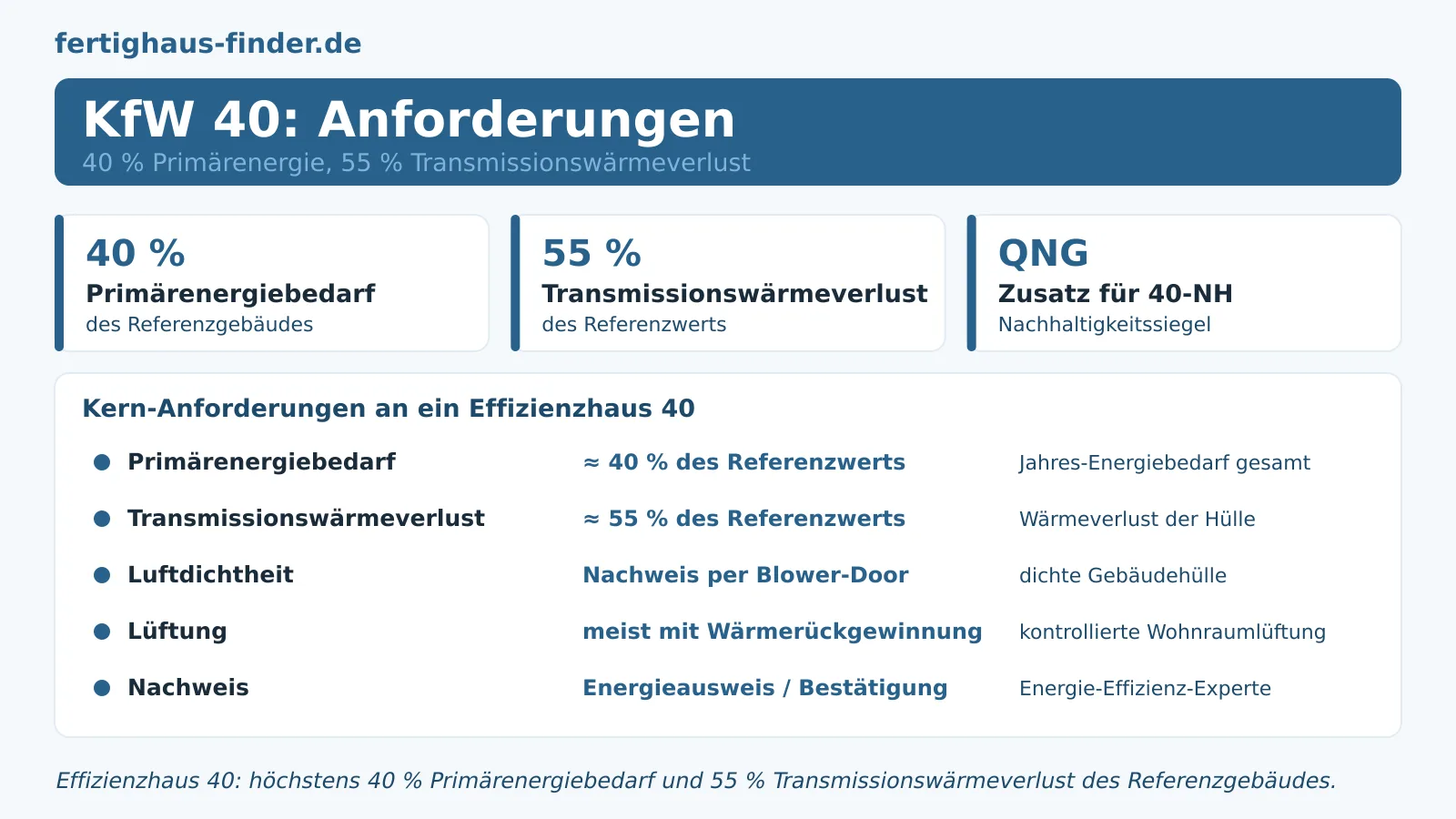
Short answer: At its core, a KfW-40 house may only consume around 40 percent of the primary energy demand of a legally defined reference building, and the transmission heat loss escaping through the building envelope may be at most about 55 percent of the reference value. These two parameters are the decisive target values; for the addition 40-NH, the Sustainable Building quality seal (QNG) is added in 2026.
What does the KfW 40 standard actually mean?
Short answer: The number 40 denotes the efficiency house standard: A KfW-40 house consumes only about 40 percent primary energy compared to a legally specified reference building. The lower the number, the more efficient the building. Thus the standard does not describe a specific building component but the overall energy result from insulation, plant technology and airtightness.
The efficiency house standard is the common language of legislator and funding bank. The house type page shows what a KfW-40 house looks like in everyday life and how it differs from the statutory minimum standard KfW-40 house. Which subsidy programs are linked to this standard is explained in our overview on KfW for house construction.
Which technical parameters must a KfW-40 house achieve?
Short answer: Two parameters are decisive: the annual primary energy demand, which may amount to a maximum of around 40 percent of the reference building, and the transmission heat loss of the building envelope, which must be around 55 percent of the reference value. Both are verified mathematically in the energy certificate. In addition, an airtight envelope and usually a ventilation system with heat recovery are required.
Core requirements for an efficiency house 40 (target values)
| Parameter | Requirement | Reference |
|---|---|---|
| Primary energy demand | ≈ 40 % of the reference value | Total annual energy demand |
| Transmission heat loss | ≈ 55 % of the reference value | Heat loss of the envelope |
| Airtightness | Proof by blower door test | tight building envelope |
| Ventilation | usually with heat recovery | controlled living space ventilation |
| Proof | Energy certificate / confirmation | by energy efficiency experts |
The calculation is performed by a qualified energy efficiency expert; the values are interdependent and can only be achieved as an overall concept. How the standard fits into the legal framework is closely linked to the Buildings Energy Act.
Compare providers suitable for KfW 40
Not every provider achieves standard 40 as a standard feature. Request free and non-binding offers and have the efficiency house standard confirmed in writing.
What is the difference between KfW 40 and KfW 40-NH?
Short answer: 40-NH stands for sustainability: In addition to the energy metrics of the efficiency house 40, the building must fulfill the Sustainable Building quality seal (QNG). This evaluates ecological, economic and socio-cultural criteria over the entire life cycle and certifies them by an accredited body. The NH standard is therefore more demanding and a prerequisite for higher subsidy tiers.
- Efficiency house 40 fulfills the energetic core metrics (primary energy, heat loss).
- 40-NH additionally requires the QNG seal with sustainability criteria.
- The QNG evaluates the entire life cycle, not only the energy demand.
- Certification is performed by an accredited, independent body.
- Higher subsidy levels generally require NH verification.
Standard and subsidy are two different things
The efficiency house standard describes the technology, the subsidy the financing. Whether and to what extent a KfW-40 or 40-NH house is subsidized in 2026 depends on the currently valid subsidy program. Check the current conditions in the KfW subsidy 2026 guide.
How do the KfW-40 standard and subsidy relate to each other?
Short answer: The construction standard is the entry ticket to the subsidy but not identical with it. Anyone who achieves the efficiency house standard 40 or 40-NH and provides all proofs can apply for subsidized loans or grants. The specific programs, amounts and deadlines change regularly, therefore the subsidy application should always be prepared before the start of construction and with an energy efficiency expert.
An overview of the current programs is given by the guides KfW subsidy 2026 and Subsidies at a glance. What distinguishes an energy efficient prefabricated house overall is explained by the guide Sustainable prefabricated house.
How is the KfW-40 standard achieved in practice?
Short answer: The standard is achieved by the interplay of several measures: strong insulation of roof, walls and base plate, triple glazed windows, an airtight envelope, a ventilation system with heat recovery and an efficient heating technology usually a heat pump, often combined with photovoltaics. No single component is sufficient on its own; the proof is provided via the overall balance.
Prefabricated houses often achieve standard 40 as standard because the prefabricated walls are highly insulated from the outset. Nevertheless have the achieved efficiency house level confirmed in writing in the building description and calculate the budget in advance with the Cost calculator.
Conclusion: Two parameters, one overall concept
The KfW-40 standard stands and falls with two key values – around 40 percent primary energy demand and about 55 percent transmission heat loss of the reference building – which can only be achieved in the overall energy concept. The addition 40-NH raises the bar above the QNG seal further. Anyone aiming for the standard cleanly separates technology and subsidy and has both verified by experts. Neutral program information is offered by the KfW.
Compare KfW-40 house free of charge
Have offers from KfW-40 suitable providers created and compare efficiency standard, equipment and prices – free of charge and non-binding.
What does your desired house really cost?
Request free matching offers from verified manufacturers and compare the square meter prices for your construction project.
Compare house prices nowImportant questions explained briefly
The most common price questions about KfW 40 – compactly answered by the editorial team of Modulhaus-Fertighaus (Stand 2026).
What does the KfW 40 standard mean?
Which key values must a KfW-40 house achieve?
What is the difference between KfW 40 and 40-NH?
How do KfW-40 standard and subsidy relate to each other?
How is the KfW-40 standard achieved in practice?
Do prefabricated houses achieve the KfW-40 standard automatically?
Matching topics
- Timber frame construction 2026: structure, advantages and disadvantages, costs
- Solid prefabricated house 2026: solid brick house in comparison
- Prefabricated house from Poland 2026: savings, law & checklist
- Shell house for self-finishing or turnkey 2026: decision aid
- Building in winter 2026: Can one build a prefabricated house in winter?
