
Residential building and elemental insurance for new build: costs and ZÜRS zones
Heavy rain and flooding are increasing, but the standard residential building insurance does not cover these damages. This guide explains what the elemental insurance provides, what it costs in 2026 (around 80 to 300 euro surcharge), how the ZÜRS zones function and what to consider when building new.
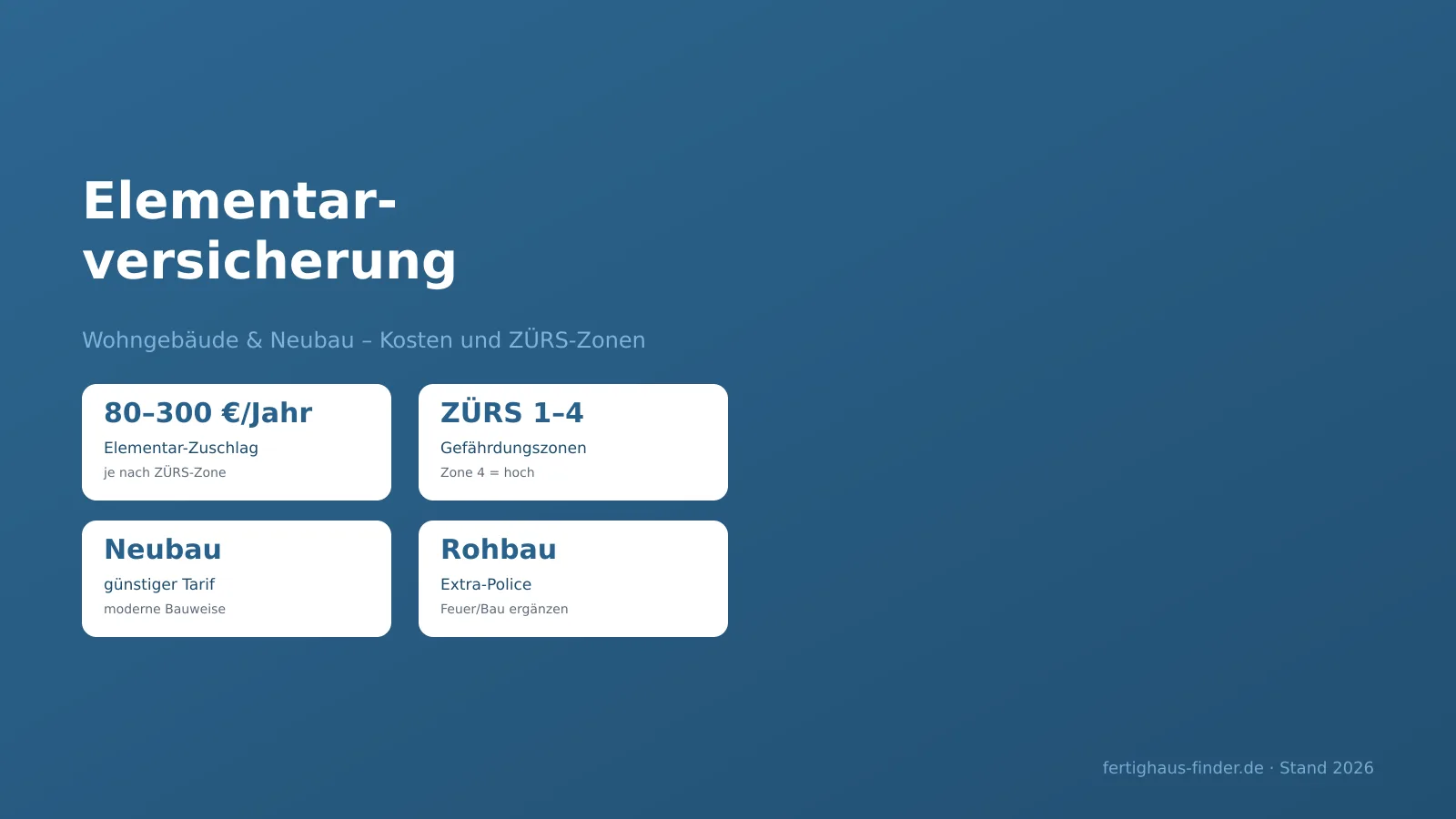
Heavy rain, flooding and inundation are increasing — and a standard residential building insurance mostly does not cover these damages. For new builds the additional elemental protection is therefore becoming increasingly important. This guide explains what the elemental insurance provides, what it costs in 2026 and what you should particularly pay attention to when building new.
Short answer: The elemental insurance covers damages by natural hazards such as flooding, heavy rain, backflow, snow load and landslide — it supplements the residential building insurance. Stand 2026 the elemental surcharge costs around 80 to 300 Euro per year depending on the ZÜRS hazard zone, significantly more in highly endangered locations. For new builds the rates are often cheaper due to modern building substance.
What does the elemental insurance cover?
Short answer: Insured are damages through natural hazards that the residential building insurance does not include: flooding and inundation, heavy rain and backflow, snow load, avalanches, earthquakes, landslide and ground subsidence. Storm and hail on the other hand are already part of the classic residential building insurance.
Heavy rain in particular can hit any building plot — even far from rivers. A flooded basement or a water backflow from the sewer quickly causes five-figure damages for which no one pays without an elemental component. Consumer protectors therefore recommend the additional protection almost nationwide today. The guide summarizes basics on the insurance package for house construction Builder-owner insurances together. Whoever wants to deepen the basics will find them in Prefabricated house at a glance.
What are ZÜRS zones — and why do they determine the price?
Short answer: ZÜRS stands for the "Zoning system for flooding, backflow and heavy rain" of the insurance industry. It divides each address into one of four hazard classes (GK 1 to 4). Zone 1 means rare, zone 4 frequent flood risk — the higher the zone, the more expensive or more difficult the elemental protection.
ZÜRS hazard classes and typical impact (Stand 2026)
| Zone | Flood risk | Impact on premium |
|---|---|---|
| GK 1 | rarer than 1x in 200 years | favorable premium, usually easily insurable |
| GK 2 | rarer than 1x in 100 years | moderate surcharge |
| GK 3 | 1x in 10 to 100 years | higher premium, possibly deductible |
| GK 4 | more frequent than 1x in 10 years | expensive, partly only insurable with conditions |
Before the building plot purchase it is therefore worthwhile to take a look at the hazard situation. The Building plot check and the guide Soil report & subsoil, because subsoil and slope water are closely connected with the elemental risk. Whoever is still considering whether the construction start is sensible now will find arguments in the guide Build now or wait?.
What is particularly to be considered for the new build?
Some particularities apply for new builds. During the construction phase the residential building insurance does not yet take effect completely — a fire shell construction insurance (often free in advance of the later building policy) and a construction insurance against storm, theft and unforeseen damages on the construction site are useful. Only with the completion does the protection transition to the regular residential building insurance with elemental component.
- Fire shell construction insurance from construction start (covers fire/lightning on the shell).
- Construction insurance against storm, theft and elemental events on the construction site.
- Conversion to residential building plus elemental insurance upon completion.
- Check ZÜRS zone before building plot purchase — it influences insurability and price.
Positive: Modern construction, current drainage and a waterproof white or brown tank at the basement can lower the risk — and thereby the premium. Whoever places the basement higher or uses a floor slab reduces the flooding risk additionally. Whether basement or floor slab fits better is explained by the comparison Basement or floor slab.
Set insurance sum correctly
Pay attention to the "sliding new value insurance": It ensures that in the damage case the reconstruction is paid at current prices — important with strongly increased construction costs. In addition check deductible and whether gross negligence is co-insured. In advance you can calculate the prefabricated house costs with our calculator and realistically estimate your budget.
What does the elemental protection cost for a new build?
Short answer: The pure elemental surcharge to the residential building insurance is in 2026 approx. 80 to 300 Euro per year depending on ZÜRS zone. In hazard class 4 the premium can be a multiple. The complete residential building insurance including elemental frequently costs around 300 to 800 Euro per year depending on the object.
Because tariffs and benefits differ strongly, a comparison of several offers is worthwhile. In addition to the price check above all the covered hazards, the deductible and the regulation for gross negligence. Further components around house construction can be found in the guide Builder-owner insurances.
Is the elemental insurance mandatory?
A legal obligation for elemental insurance does not exist Stand 2026 in Germany — the conclusion is voluntary. In view of increasing extreme weather events a mandatory insurance is however discussed politically. Independently of that consumer advocates recommend the additional protection almost across the board because damages through heavy rain and flooding can hit everyone and are not covered without elemental component. Whoever takes up a construction financing secures with a comprehensive policy at the same time the value that serves as security for the loan.
Check when concluding whether your residential building insurance already includes the natural hazards component or offers it as an add-on. For new builds, the component can usually be included without complication from the beginning — this is also a reason to consider the insurance already in the planning phase.
How can the premium be reduced?
Several levers influence the premium. An agreed deductible lowers the premium but shifts part of the risk to you. Structural protection pays off: a backflow preventer in the sewer, a watertight basement sealing, raised electrical distributions and a good building plot drainage reduce the damage risk and thus partly the premium. The choice of location also has an effect — a building plot in a low ZÜRS zone is cheaper and easier to insure.
Compare several offers and pay attention not only to the price but to the scope of coverage: Are all relevant natural hazards included, how high is the deductible, and is gross negligence also insured? A favorable policy with large coverage gaps helps little in an emergency. The guide summarizes which further protections during construction are useful Builder-owner insurances together. The insurance coverage should be in place in time for the move — the appropriate steps are listed in the Move-in checklist on.
Plan prefabricated house — consider insurance from the beginning
Describe your project once — we will forward it to suitable providers. Free of charge and non-binding, Stand 2026.
What does your desired house really cost?
Request free suitable offers from verified manufacturers and compare the square meter prices for your construction project.
Compare house prices now