
Building on inherited building plot: from certificate of inheritance to start of construction
An inherited building plot is an opportunity but requires preliminary work: first the proof of inheritance and the land register must be clarified, a community of heirs must agree and the buildability must be checked. This guide leads from the certificate of inheritance through the land register correction to the start of construction and classifies the tax basics.
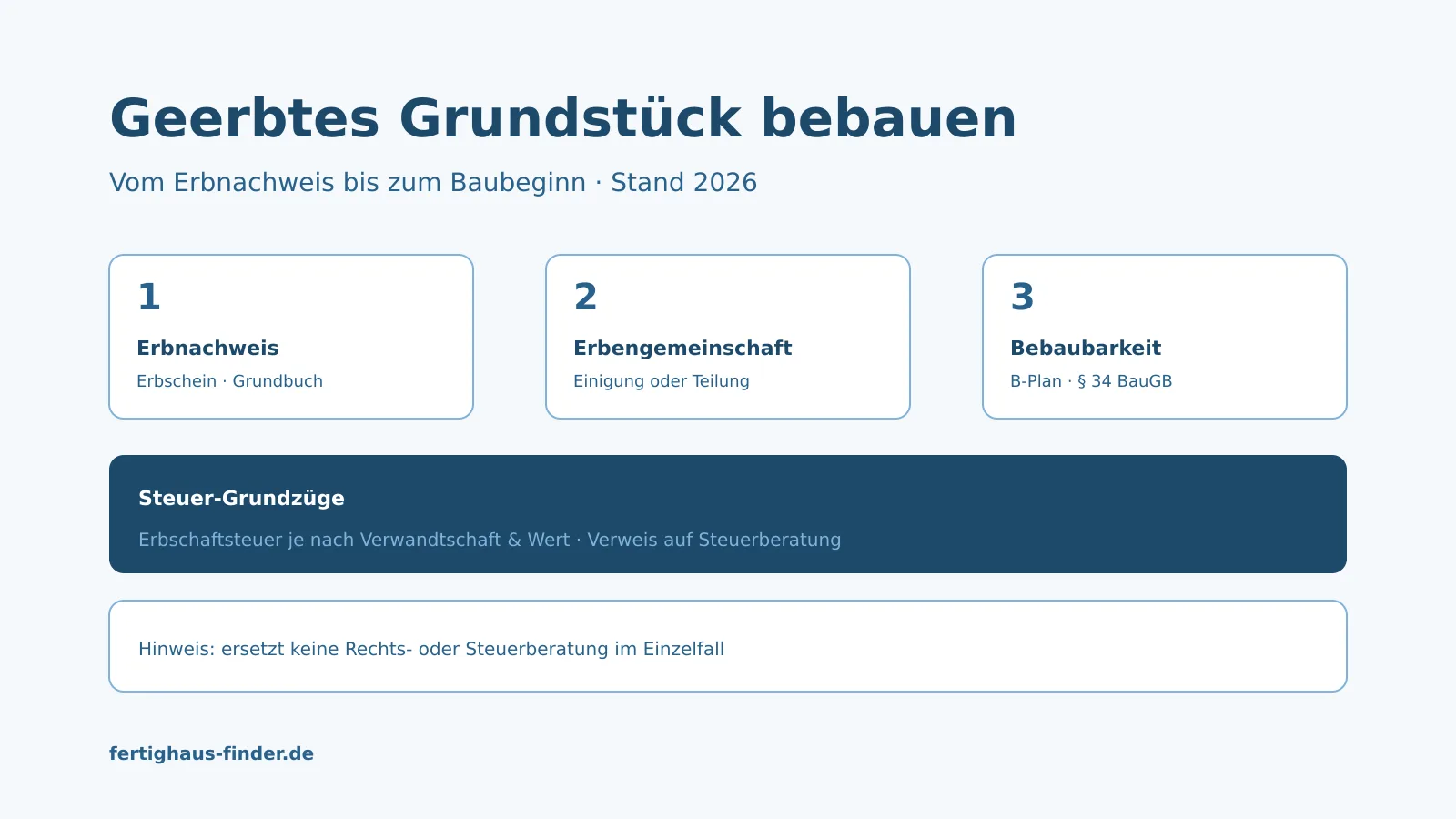
An inherited building plot is a major opportunity but can also cause delays: first the proof of inheritance and the land register must be clarified, a community of heirs must reach an agreement and the buildability must be checked. This guide leads through the steps from the certificate of inheritance to the start of construction and classifies the tax basics. How the future house can look is shown in our guide to prefabricated house at a glance; the budget can be calculated in advance in the calculate prefabricated house costs.
Important note
This post provides general orientation and does not replace legal or tax advice. For inheritance law, land register correction and inheritance tax, have yourself advised by a notary, lawyer or tax consultant in the individual case.
Short answer: Before building on an inherited building plot, three things must be in place: the proof of the right of inheritance (certificate of inheritance or notarized will) and the land register correction, the agreement within a community of heirs as well as the check of the buildability via development plan or building authority. Only then follow planning and building application - clarify tax questions in parallel with expert advice.
What must be clarified first: certificate of inheritance and land register?
Short answer: Heirs are not automatically entered in the land register as owners. Proof of the right of inheritance is required - a certificate of inheritance or a notarized will with opening protocol. This allows the land register correction to be applied for, which is possible free of charge within a period after the inheritance. Without a corrected land register, credit and construction can hardly be realized.
- Obtain proof of inheritance: use certificate of inheritance at the probate court or notarized will.
- Apply for land register correction at the land registry office - often free of charge within the deadline.
- Check existing encumbrances (land charges, rights of way and usufruct rights in sec. II/III).
- Match plot data and boundaries with the cadastral extract.
A frequently underestimated point is contaminated sites and rights that are registered in the land register. In department II, for example, there are rights of way, residential rights or usufruct, in department III land charges and mortgages. Such encumbrances can restrict buildability or make financing more difficult - for example if a lifelong residential right of a relative is registered. Therefore request a current land register extract and have the entries checked before you invest time and money in the planning.
How the land register and notary work in principle is explained in the guide Notary costs & land register.
How do I deal with a community of heirs?
Short answer: If several persons inherit jointly, they form a community of heirs and can only dispose of the plot by mutual consent. Anyone who wants to build alone must pay out the others or divide the plot in reality, if this is permissible under planning law. Without an agreement, a division auction is threatened - therefore an early, fair coordination is worthwhile.
Ways out of the community of heirs for the building plot
| Path | How it works | To note |
|---|---|---|
| Payout | one heir takes over, pays the others out | Determine value, secure financing |
| Physical division | Plot is divided into parcels | only if permissible under building law |
| Build jointly | all build or utilize together | requires permanent cooperation |
| Sale | Plot is sold, proceeds are divided | simplest solution in case of disagreement |
Start construction project on the inherited plot
Once land register and buildability are clarified, compare house offers from several providers free of charge and without obligation for price, floor plan and construction time.
How do I check whether the plot is buildable?
Short answer: Whether and how you may build is determined by the development plan of the municipality or - where none exists - according to the surroundings pursuant to § 34 BauGB in the inner area. Decisive are the permitted use, building density, building lines and the development. A preliminary building inquiry at the building authority creates early clarity before you plan and sign contracts.
In addition to planning law, the development decides whether an inherited building plot is economically buildable. If the plot is located in a new development area, it is usually already connected to street, sewer, water and electricity. If, on the other hand, it is a long-held family plot in the outer area or a building gap, significant development costs may be incurred or a development may even be completely ruled out. The building ground itself - load-bearing capacity, groundwater, possible contamination - should be checked by a soil survey before you plan.
How to classify buildability, plot value and building boundaries is shown by the guides Find and evaluate building plot and Plot issues in house construction. Whether the plot is developed is clarified with the guide Develop plot. If own development is not an option, the selling section shows how a sale proceeds step by step and which costs and tax basics on sale must be observed.
What tax basics should I know?
Short answer: When inheriting a plot, inheritance tax may apply. High tax-free allowances apply for close relatives, significantly lower for more distant heirs. The tax value of the plot is decisive. Whether and how much tax is due depends on the degree of kinship, allowance and value - the calculation belongs in the hands of a tax consultant.
Reference to tax consultation
Allowances, valuation and possible tax exemptions (for example for the family home) are complex and depend on the individual case. Have the inheritance tax and its deadlines checked at an early stage by a tax consultant before deciding on development or sale.
The following order applies: First clarify the legal and tax issues before starting the construction planning. Anyone who commissions an architect, building application and provider without the land register and community of heirs being settled risks lost planning costs if the project fails. It also makes sense to speak to the financing bank early: It requires an updated land register and unencumbered conditions as security. Only when the certificate of inheritance, agreement in the community of heirs and buildability are established is it worth comparing specific house offers.
Conclusion: First clarify the legal situation, then build
An inherited building plot can be well developed if the certificate of inheritance and land register, the community of heirs and the buildability are clarified. Anyone who coordinates tax issues early with a tax advisor avoids unpleasant surprises. Official information on inheritance law is provided by the Federal Ministry of Justice. If the building plot is large enough for several units, it is worth looking at the overview of the multi-family house and on the guide Develop building plot with multi-family house.
Plan house on the inherited building plot
Compare offers from several providers free of charge and without obligation and have the floor plan, price and construction time confirmed in writing.
What does your desired house really cost?
Request suitable offers from verified manufacturers free of charge and compare the square meter prices for your construction project.
Compare house prices